Thursday, July 11, 2013
Wompanoag Paddle '13
Executive director of the NSRWA, Sam Woods, and I canoed along side kayaker Dorie Stolley, a representative of her business Three Birds Consulting as well as the US Fish and Wildlife Services at which she served as a wildlife biologist.
The paddle itself was one of remarkable landscape and serene nature. The wind was endless but the surrounding beauty served enough of a distraction. Along the bank of the North River about 5 miles into the paddle there was a camping site that participants were allowed to make a pit stop at to grab a bite or take a dip. Sam, Dorie, fellow intern Sara Head, and I tested the water out after working our upper bodies to the brink. The temperature of the river was quickly adaptable and the current was strong enough that when we swam against it we wouldn't move foward at all. Like natures own resistance pool!
The Wompanoag Paddle was a great experience that I and many others were fortunate enough to share together. I look forward to participating in it again next year!
Tuesday, July 2, 2013
Boat Tour with the Town Managers
By Emily Pitman
Last Friday I had the opportunity to go out with the managers of the towns located on the North and South River. While it was initially rainy, the clouds cleared in time for Norwell Jim Boudreau, Duxbury Rene Reed, Scituate Patricia Vinchesi, and Marshfield Rocco Longo to accompany Sam, Sara and I on the tour. The boat ride was provided by Marshfield Harbormaster Mike DiMeo.
Friday, June 21, 2013
And Then There's Margo
I've always had an affinity for the natural world and the diverse life it holds. When I was a kid I remember learning about the Ring of Fire in elementary school and was completely mesmerized and astounded. Ever since then I dream of becoming a volcanologist! Usually when I say that people go, "Oh so like Dante's Peak?", yes except unlike Mr. Brosnan I'm a real scientist ;-D
Working with the NSRWA for the past few weeks has already been an awesome experience with only greater and more memorable things to come! Lookin forward to it indeed! Later!
- Margo (aka Polo)
![]() |
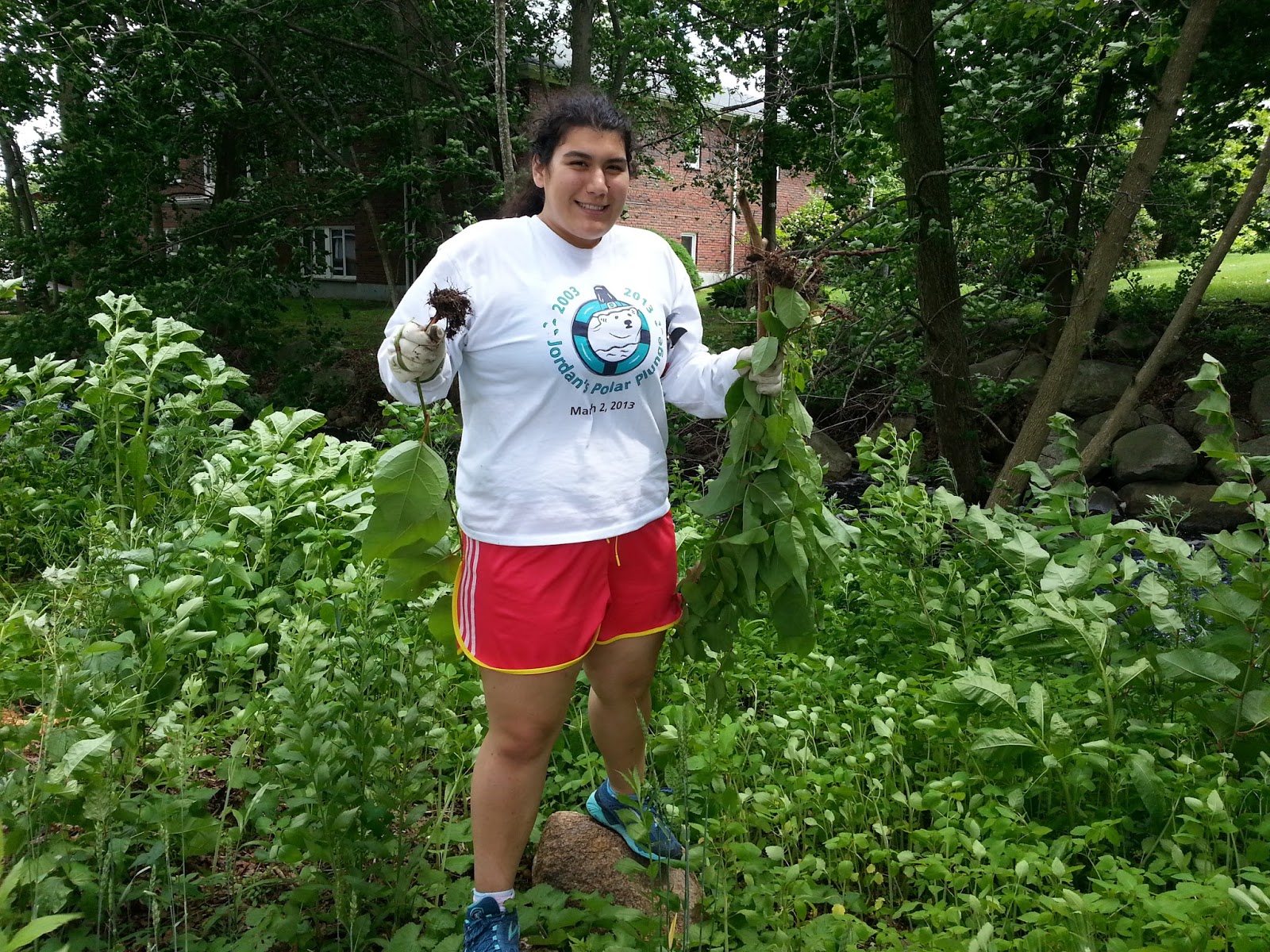
| Check out that knotweed yield. |
Tuesday, June 18, 2013
Intern Number Four, Alex Rozen
| Emily (in the blue) and I (in the pink) staking out the quadrats (top) and in front of the purple loosestrife plant (bottom) |
Monday, June 10, 2013
Another New Summer Intern-Sara Head
Hi everyone! My name is Sara Head and I am one of the NSRWA's new summer interns. I am from, and currently reside in Marshfield, MA. For those familiar with the area, I live on Damons Point, located across from the mouth of the North River and The Spit. Naturally, I developed a love for the rivers and surrounding ecosystems from years of kayaking and boating with my family. This passion led me to study Environmental Geology in college. I attended Eckerd College, on Florida's Gulf coast for my freshman and sophomore years, and recently transferred to Bridgewater State University. I will be a senior this fall, and plan to continue my education in Paleontology and Paleoclimatology later in grad school.
For now, I am the secretary for BSU's Geological Society, where we host guest lecturers and go on field trips to significant geological sites. We recently went to the Big Island of Hawaii in the Spring to study volcanoes and magma composition!
As an intern, I am extremely excited to put my love for nature to work in the field! The NSRWA currently has several projects underway, including the removal of Japanese Knotweed, which I took part in with my fellow interns on my first day.
Japanese Knotweed is a highly invasive bamboo-like plant that grows mostly along rivers and streams. As the name implies, the plant originated in Asia and has now made itself quite dominant here in our watershed communities. The Knotweed may look pretty, but it actually limits biodiversity of species in an ecosystem, deeming it an "invasive species". The plant is spread when it is uprooted and transported to new locations, usually through waterways.
Last Thursday (June 6th), we removed nearly all of the Japanese Knotweed from South River Park in Marshfield, hopefully allowing for more plant life to flourish there. Removal of the leaves and stalk will prevent further photosynthesis and the remaining roots were treated with an organic Sodium Chloride herbicide.
For more information on Japanese Knotweed, please check out these websites:
http://www.ecy.wa.gov/programs/wq/plants/weeds/aqua015.html
http://your.kingcounty.gov/dnrp/library/water-and-land/weeds/Brochures/knotweed-brochure.pdf
I am very excited to continue working with the NSRWA and get my hands dirty with more projects, and I look forward to blogging more about my experiences!
Until next time,
~Sara Head
Tuesday, June 4, 2013
Introducing One of Our Summer Interns- Emily Pitman
My love of nature developed from when my family spent countless weekends camping and playing outside. My recent adventures scuba diving and hiking have allowed me to experience some of the fantastic geographic highs and lows. In my spare time and on more level groung, I love hiking, sailing, and playing rugby.
As an intern as NSRWA, I'm looking forward to helping with community and ecological opportunities. My first few days have been spent getting settled in the office, helping on a project in the field, and prepping spat settlement tiles for mussels, and I look forward to seeing what else is in store for me this summer. I'm excited to meet all of the dedicated individuals that support NSRWA, and hope to write more blog post about my experience in the future!
-Emily
Friday, September 21, 2012
Summer Internship Report - Adrienne Lohe
Adrienne Lohe is a senior at Santa Clara University majoring in Environmental Science, and was an intern with the NSRWA this past summer. We asked her to write a bit about her experience.
This summer as an intern for the NSRWA, I gained valuable experience and had a lot of fun in the rivers, coasts and marshes that they protect. My first project was volunteering at an invasive species removal in Marshfield. After cutting Japanese Knotweed from the banks of the South River Park for several hours in the 100 degree day, I became aware of how committed and passionate all of the volunteers were to protecting this river ecosystem. These people actually cared about the environment around them and worked to make a change--I was impressed and knew that NSRWA would be a perfect fit for me.
After that I was excited to get started with field projects. I worked closely with ecologist Sara Grady, who led all of the research but taught me along the way so that soon the other interns and I were able to gather data on our own. We did surveys of invertebrate life in Marshfield’s Green Harbor as well as Phragmites and other vegetation surveys. This allowed us to monitor the changes in the environment in response to the changing of the tide gate. The first time we surveyed for invertebrates Sara did all of the identifying, but the next time I’m proud to say that my fellow intern Laura and I completed the whole day of work by ourselves! It was an awesome hands-on learning experience from trying not to fall down in the harbor mud to examining tiny worms under the microscope for the afternoon.
Some of my favorite projects were impoundment surveys at First Herring Brook. Kayaking around the Scituate Reservoir, we took several measurements such as depth, temperature and dissolved oxygen. It was interesting to see the differences at varying depths as warmer water on top did not mix with the colder, life-supporting water close to the bottom. As a Scituate resident, I loved working on and learning about this ecosystem that I had driven by and fished on as a kid, but knew almost nothing about. Another of my favorite projects was horseshoe crab tagging. Sara, Laura and I spent a few hours walking in the shallows of Duxbury looking for crabs. Afterwards we drilled holes in their shells to tag them and monitor their populations, which are an indicator of the health of a coast. I’ve always been interested in marine science and I loved getting to work in the ocean.
This summer gave me lots of hands-on experience in the field of environmental science, taught me a lot about scientific research, and gave me some ideas about what to do in the future. As a graduating senior this spring, I look forward to using these past few months of work as stepping stones to more work in environmental and ecological sciences.